







You can complete a workout without eating first. The question is how much you actually get out of it.
For many it becomes a bit random what happens before training. Some eat something quick, others skip it entirely, and many are unsure what actually makes a difference. That’s also why there is so much focus on the “perfect” pre-workout meal. In practice, however, the problem is rarely there.
It is rarely the wrong meal before training that ruins your workout; it is lack of energy.
In this article you won’t get a list of perfect meals. You’ll get an explanation of what actually matters if you want to get something out of your training.
Should you eat before training?
Yes, in most cases it makes sense to eat before training, because the body needs energy to perform.
When you train, the body uses what is available. If there isn’t much energy to draw on, it will affect how hard you can push yourself and how long you can maintain the level.
That doesn’t mean you can’t train without eating first. You can. But it changes the quality of the work you put into the training.
For some, training on an empty stomach works fine, especially if the session is short or not very intense. For others, the effect on energy levels can be noticeable quickly. It depends partly on when you last ate and how demanding your workout is.
So it’s not about a fixed rule, but about understanding what actually affects your training in practice.
What happens if you don’t eat before training?
If you don’t eat before training, the body works with limited resources.
That can mean you get tired faster, struggle to maintain intensity, and don’t push yourself the same way as usual. You still complete the workout, but the quality drops.
If you don’t have energy, you’re not training worse, you’re just training less effectively.
That’s also why the difference isn’t always obvious from one session to the next. You can have an “okay” workout without having eaten, but over time it means you consistently work at a lower level than you otherwise could.
Imagine two workouts with the same exercise. One day you’ve eaten and have energy, the other day you haven’t. The difference will often be how many repetitions you can do, how heavy you can lift, and how much you actually challenge your body.
And that is precisely where the difference emerges over time.
What should you eat before training?
Before training it’s primarily about giving the body energy so you can perform.
This isn’t the time to optimize every detail. It’s about ensuring the body has something to work with when you start. If energy is lacking, the quality of your training drops, no matter how good your plan is.
Energy directly affects how much you can push yourself, how heavy you can lift, and how long you can maintain intensity. If you lack energy, your sets end before the muscle is sufficiently stressed, and you don’t get the stimulus that creates progress.
You don’t get a better workout from being “light”; you get a better workout from having energy. In practice, that means many get the most out of their training if they’ve eaten something relatively simple beforehand. It can be something as ordinary as porridge, a slice of bread, or a piece of fruit. Not because it’s special, but because it gives the body something to work with.
Protein before training is not decisive, but can be part of a meal.
The most important thing is not whether you hit protein right before training, but whether you get enough throughout the day. If that’s in place, a pre-workout meal can include protein, but it’s not what determines whether your workout will be good.
If you want to dive deeper into how much protein actually makes sense for your training, you can find a detailed review in our article on how much protein you need for strength training.
There are, however, some things that often make training worse if they are too close to the session.
Very heavy food, large meals, or fatty food right before training can feel like it’s “in the way.” It’s not that it’s unhealthy, but that the body is still digesting when you try to perform.
How long before training should you eat?
Most people feel best eating 1–3 hours before training, depending on the meal size.
A larger meal makes sense a couple of hours before, so the body has time to digest it. Smaller meals can be closer, and if you only have time for something quick, a light snack can often be enough to provide some energy.
It’s not about the perfect moment, but about avoiding two things: being completely empty and feeling heavy in the body when you start. For many it becomes too rigid when it’s turned into a question of minutes. In practice it works better to find a rhythm that fits everyday life and that can be repeated.
What does it mean in practice?
If you train in the morning, something light that gives a bit of energy without feeling heavy can be enough. For others it makes more sense to eat a proper meal if there is time.
If you train later in the day, it will often be more about how your earlier meals have been composed. If you’ve already eaten during the day, something smaller before training may be enough to give that final boost.
It can be as simple as a bowl of oats with a bit of skyr in the morning, a meal with bread and a protein source later in the day, or just a piece of fruit and something light if time is tight.
This is also where many find it falls apart. Not because they don’t know what to eat, but because it’s not done consistently in a busy everyday life. And it’s consistency that makes the difference over time.
Typical mistakes before training
When it doesn’t work before training, it’s rarely because someone does something completely wrong. It’s the small things that repeat that make the difference.
A classic mistake is skipping the meal. Not necessarily intentionally, but because there isn’t time or energy. The result is you start training with too little energy and never really push yourself.
Another is eating too late. The meal still feels heavy when you start, and it affects both movement and intensity. It doesn’t necessarily feel like a big problem, but as mentioned the quality of the training falls.
There is also a tendency to focus too much on timing. You try to hit a specific time or the “right” meal, even though the total intake over the day isn’t in place. It quickly becomes a way to optimize details while the foundation is missing.
And then there are those who overcomplicate it. Searching for the perfect solution, testing different strategies and ending up making it harder than it needs to be. Most people don’t get a poor workout because they eat wrong, but because they don’t get enough energy during the day.
How does this relate to the rest of your diet?
What you eat before training plays a role, but it can’t stand alone.
If the rest of your diet doesn’t support what you do, one meal before training won’t make much difference. Conversely, a very simple pre-workout meal can work fine if you otherwise get enough energy and protein throughout the day.
Pre-workout is one piece. The whole determines whether you get results.
If you want to understand how diet and training fit together as a whole, you can read our review of nutrition for strength training. And if you want to see what makes sense to do after training, you can dive into our article on what to eat after training.
What you eat before training affects your performance, while what you eat the rest of the day determines your results.
For it to work in everyday life
In a busy everyday life this is where it can fall apart. The training may be completed, but what happens before and after becomes random. Some days it works, other days it doesn’t. And that’s enough for the overall benefit to be lower than it could be.
That is also why structure matters more than perfection.
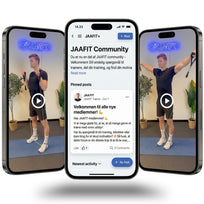
If you already have your training under control but are missing a way to make diet and training fit together in practice, it can make sense to work with a fixed framework. In JAAFIT træningsappen you will find, among other things, programs and an overall structure that make it easier to get everything to work without inventing it every time.
If you want to dive further into training, diet and structure, you can find more concrete guides in the blog universe.
That’s why it’s not about the perfect meal
It’s easy to focus on details like timing and specific meals because they feel concrete and controllable. But in practice that is rarely what determines your results.
It’s more about whether you give the body what it needs – again and again – and whether it’s something you can stick to over time. A good workout doesn’t start with the perfect meal. It starts with making it simple enough to repeat.




Leave a comment
This site is protected by hCaptcha and the hCaptcha Privacy Policy and Terms of Service apply.