









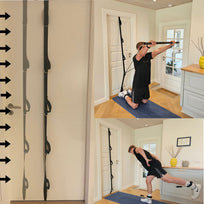

Progressive overload means that you gradually increase the load on your muscles over time, so the body always has a reason to get stronger. In English it is called progressive overload. It is the most fundamental principle in all strength training, whether you train with weights, machines, or resistance bands.
Most people know the problem. The first weeks with a new program progress is fast. Then it levels off. The exercises feel easier, but the body no longer changes. This is rarely due to lack of effort. It is because the load has stayed the same while the body has adapted to it.
Why the body demands more over time
Muscles adapt to what they are exposed to. When you load a muscle more than it is used to, the body responds by making it stronger and, over time, larger so it can better handle the same load next time. That load is called mechanical load, and it is the primary driver behind both strength and muscle growth.
But adaptation only works as long as there is something to adapt to. If you do the same training with the same resistance, the same sets, and the same repetitions week after week, the body no longer gets a signal to change. The answer to how you get stronger is therefore not to train as hard as possible from day one. It is to increase the load a little at a time and keep doing so.
If you want to understand what happens inside the muscle itself, we have written more about the mechanisms behind muscle growth.
Six ways to increase load with resistance bands
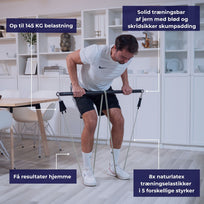
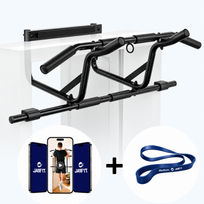
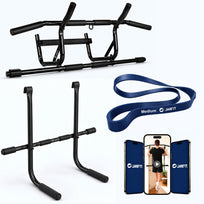
With free weights progression is simple to understand. You add 2.5 kg more to the bar. With bands the small increments don’t exist in the same way, and that leads many to believe band training has a ceiling. It doesn’t. There are just more things to adjust. JAAFIT PRO provides adjustable resistance up to 145 kg, but resistance is only one of six ways to increase load.
| Method | How to do it with bands |
|---|---|
| Heavier or more bands | Switch to a stronger band, or combine multiple bands on the same handle or bar |
| Greater distance to the anchor point | Step one step further away from the door, or stand wider on the band so it is more stretched from the start |
| More repetitions | Keep the same resistance, and add one or two repetitions per set before increasing resistance |
| More sets | Go from three to four sets in exercises where you stay in place |
| Slower tempo | Use three to four seconds on the part of the movement where the band pulls you back |
| One leg or one arm at a time | Perform the exercise one side at a time so each side must handle the full resistance alone |
Order matters. The simplest approach is to start with repetitions. For example, if you work with 8 to 12 reps, build up until you can do 12 in all sets with good technique. Then switch to a heavier band and start again around 8. That gives a clear plan for sets and reps so progression in strength training isn’t a guess each time.
Tempo is the most overlooked tool. Eccentric training, where you deliberately work the part of the movement where the muscle lengthens under load, increases the time the muscle is working. This is called time under tension, and it doesn’t require more resistance. With bands it is particularly effective, because the band pulls hardest when it is most stretched, and that is exactly where you should slow the movement.
There is one exception where progression goes the other way. For assisted pull-ups with PowerBands it is the band that helps you up, and progress therefore means a lighter band. You start with Heavy, move to Medium and Light, and finish without assistance. We have described the entire path to your first pull-up step by step.
When to increase and when to hold back
The most used rule of thumb is reps in reserve. It is the number of repetitions you have left when you stop the set. If you have three or more left in the last set, the load is too light. If you have zero, you have gone to the limit. Most of your training should be with one to three repetitions in reserve. When the last set starts to feel easier than usual, it’s time to increase.
That requires that you know what you did last time. A training log doesn’t need to be more than a note with exercise, resistance, sets, and repetitions. Without it, it is hard to see if you are actually moving forward. In JAAFIT Træningsappen there is a separate guide to tracking your progress so you have an overview from session to session.
How often should you strength train to allow for progression? For most people it makes sense to train each muscle group twice a week. That provides enough signals to drive progress and enough time in between for the body to adapt.
And sometimes the right thing is to hold back. If you are stuck on the same exercise for two to three workouts in a row, even though sleep and nutrition are in place, a deload can help. A deload week is a planned week with lower load, for example half as many sets or a lighter band. Here the body gets time to recover from accumulated fatigue, and many experience coming back stronger. If soreness and fatigue are significant, we have collected what helps sore muscles after training.
Progressive loading is not a method reserved for the experienced. It is the basic principle that determines whether your training goes anywhere. With the right home strength training equipment you can keep increasing load for a long time without having to go to a gym.



Leave a comment
This site is protected by hCaptcha and the hCaptcha Privacy Policy and Terms of Service apply.