

You can train three times a week, follow a program and still stay in the same place month after month.
For many it feels like the training is what does not work. But in practice it is rarely where the problem lies. Training is what initiates development. The load tells the body that it must become stronger. But it is not the training that builds something. It is what you do the rest of the day.
If your diet does not support the work you put into your training, the results will either be absent or progress significantly slower than they need to.
Why diet is crucial for your strength training
Diet is crucial for strength training because the body cannot build something out of nothing.
When you strength train, you break the body down. The muscles are loaded, and small damages occur in the muscle fibers, which the body subsequently repairs and adapts from. It is that process that makes you stronger. But the body can only carry out that process if it has something to work with.
If energy and nutrients are lacking, the body begins to economize. It deprioritizes muscle building and instead uses resources to keep you going. You can complete the training, but nothing really happens.
You cannot compensate for poor diet with good training. One part cannot stand alone.
A typical example is a person who trains three times a week but eats randomly throughout the day. Maybe they skip a meal, maybe it becomes a bit too quick and a bit too little. The training is there, but the body never gets the resources needed to respond to it. The result is often the same. You feel like you are doing the right thing, but nothing really happens.
Why you don’t get results from your training
When diet and strength training do not work together, it is rarely because you do something obviously wrong.
It is the quiet things that repeat. You eat a little too little. You get too little protein to support muscle building. You eat "healthy", but not enough to create progress. Or there is no connection between when you eat and when you train.
It can feel like you are doing the right thing. You choose healthy ingredients and avoid the "unhealthy". But the body does not care whether something looks healthy. It only responds to what it actually gets, and whether it is enough.
It is not about eating perfectly. It is about eating enough of the right things, consistently.
What the body needs
Diet for training does not need to be complicated. In practice it is about a few basic things that must be in place if the body is to respond to your strength training.
Protein is what builds the muscles
Protein is what the body uses as building material when it has to repair and strengthen muscles after training. Without protein there is nothing to build with, no matter how consistent your training is.
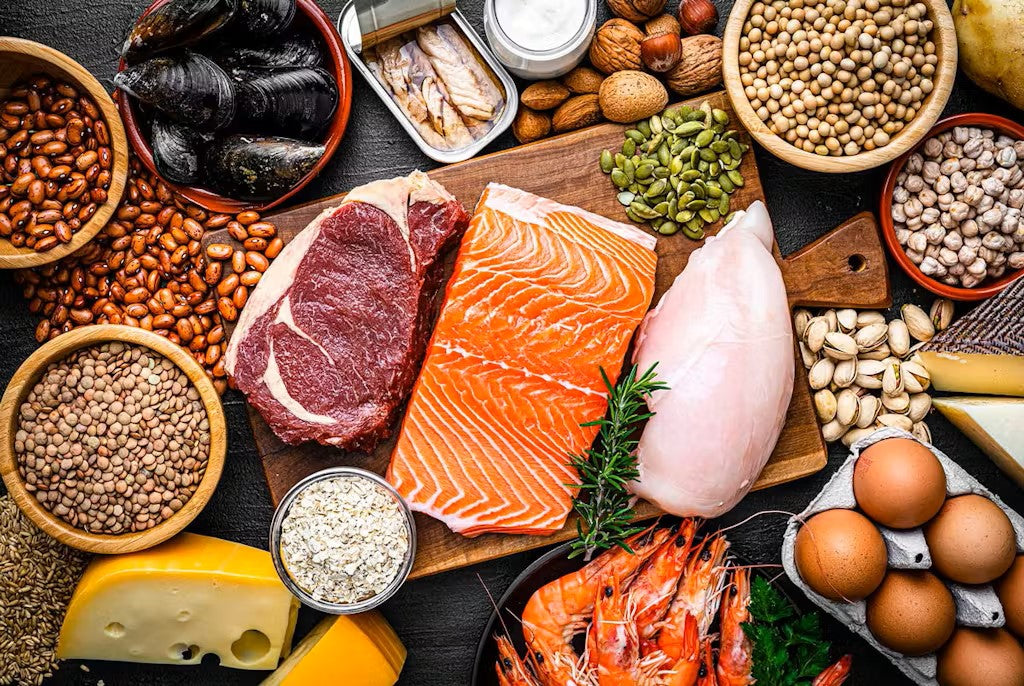
In practice protein comes from ordinary foods like eggs, chicken, fish, skyr and legumes. It does not need to be advanced, but it must be sufficient and distributed over the day's meals.
If you want concrete numbers on what actually makes sense in relation to your weight and training level, you can read our review of how much protein you need for strength training.
Energy is what makes the work possible
The body needs energy to perform and recover. Both during the training itself and in the hours and days after.
If your energy intake is too low, it will affect how much you can perform and how well the body can recover afterwards. Many experience this as feeling flat and heavy instead of stronger, even though they train. It is not necessarily the training that is the problem. It is the fuel.
Timing is only relevant when the basics are in place
There is a lot of focus on what to eat precisely after training, and whether you hit the right window. It can make sense to get protein around training because the body is busy repairing itself. But timing does not change the most important thing. If you do not get enough over the day, it does not matter when you eat it.
For most it is more about a stable distribution of meals over the day than hitting a specific time precisely.
What about supplements?
It is one of the questions that most often comes up in connection with diet and strength training: Are supplements necessary?
The short answer is no. Not as a starting point.
Protein powder is the supplement most relevant for people who strength train, and it is basically just a convenient source of protein. It is neither special nor necessary, but it can be practical if you have difficulty reaching your protein need through food alone. Creatine is another supplement with documented effects on strength and muscle mass, but it is an extra layer, and only relevant when the basics are in place.
Most people looking at supplements do not lack a supplement. They lack control of their food.
If you do not consistently get enough protein from your diet, a scoop of protein powder does not help much. And if energy intake is too low, no supplement solves it. Start with the food, and then assess whether there is still a gap.
Typical mistakes that hold your results back
When diet does not match training, it is rarely because you do something blatantly wrong. It is the quiet things that repeat over time.
A classic mistake is eating "too healthy", but too little. You choose light meals, cut calories and skip snacks, and end up not giving the body enough energy to develop.
Another is believing that protein primarily is about shakes and supplements. In practice most protein comes from regular food. If that is not in place, supplements do not change the problem.
Many also skip meals during the day. Not necessarily intentionally, but because everyday life fills up. The result is that the body never gets a stable supply of energy and nutrients. And then there is the lack of structure. You eat a bit differently from day to day, without it being connected to the training. It can work in short periods, but over time it becomes difficult to create progress.
Diet and muscle building are more closely linked than most think
Training starts the process. Diet determines whether the body can complete it.
The two things do not work in parallel, but they depend on each other. It is precisely that connection that makes many able to train consistently for a long time without seeing the progress they expect. Not because the training is wrong, but because the diet does not keep up.
If you want to understand what actually drives muscle building physiologically, and what it takes for the body to respond to your training, you can go deeper in our article on how you build muscle mass.
When it does not come together in practice
Most know what they should do. They know they should get protein, eat regularly and get enough energy. The problem is rarely lack of knowledge.
The problem is that it is not done consistently.
In a busy everyday life this is where it falls apart. The training may be completed, but the meals become random. Some days it works, other days it does not. And that is enough for the results to be absent.
That is why structure matters more than perfection. If you lack a way to get diet and training to fit together properly in practice, it can make sense to work with a fixed framework. In JAAFIT training app you will find a complete diet plan with concrete meals and recipes designed to support your training in everyday life without having to invent it from time to time.
That is why results are not only about training
Most are looking for the next exercise, the next program or the next method.
But in practice it is rarely what is missing. Results occur when the basics come together. When training, diet and structure work in the same direction, and when it is repeated over time.
If your training is in place but the results are absent, it is worth looking at whether the diet actually supports the work you put in. With a setup like JAAFIT PRO home training set you can create the load the body needs. But it is the diet that determines whether the body can respond to it.
You can find more guides on training, diet and structure in our blog universe.



Leave a comment
This site is protected by hCaptcha and the hCaptcha Privacy Policy and Terms of Service apply.